
USB connector dimensions reference
Quick answer
- USB Type-A measures 12.0mm x 4.5mm at the contact opening, USB Type-C measures 8.34mm x 2.56mm.
- Dimensions are nominal and can vary slightly between manufacturers, always check datasheets for critical panel cutout work.
- Access Communications stocks USB cables and hubs across the full range of connector types.
The physical dimensions of USB connectors are critical for designing enclosures, planning panel cutouts, identifying connectors in the field, and specifying replacement parts. This guide provides exact measurements for every USB connector type from the original USB Type-A through to modern USB-C, with comparison tables, individual specifications, and notes for installers.
For USB pin assignments and wiring colour codes, see our USB Pinouts and Wiring guide. For USB standards, speeds, and Power Delivery, see our USB Overview.
USB connector dimensions at a glance
The following table provides the physical dimensions of each USB connector type. Measurements show the contact opening of the receptacle (socket), which is the standard reference point for panel cutouts and product design.
| Connector type | Width (mm) | Height (mm) | Pins | Common use |
|---|---|---|---|---|
| USB Type-A (Standard) | 12.0 | 4.5 | 4 (USB 2.0) or 9 (USB 3.0) | Computer hosts, hubs, peripherals |
| USB Type-B (Standard) | 8.45 | 7.78 | 4 (USB 2.0) or 9 (USB 3.0) | Printers, scanners, larger peripherals |
| Mini-USB Type-A | 6.85 | 1.8 | 5 | Legacy mobile devices (deprecated) |
| Mini-USB Type-B | 6.85 | 3.0 | 5 | Older cameras, MP3 players (legacy) |
| Micro-USB Type-A | 6.85 | 1.8 | 5 | Rare in practice (deprecated) |
| Micro-USB Type-B | 6.85 | 1.8 | 5 | Older Android phones, accessories |
| Micro-USB 3.0 Type-B | 12.25 | 2.45 | 10 | External hard drives |
| USB Type-C | 8.34 | 2.56 | 24 | Modern phones, laptops, tablets, displays |
Note: Dimensions are nominal and may vary slightly between manufacturers. Always check manufacturer datasheets for critical applications.
Detailed connector dimensions
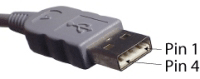
USB Type-A (Standard)
The original and most recognisable USB connector. Used on computer hosts, USB hubs, and the upstream side of USB cables.
- Receptacle contact opening: 12.0 mm (W) × 4.5 mm (H)
- External housing: Approximately 14 mm (W) × 7 mm (H) including shielding
- Plug body length: Approximately 12 mm
- Pins: 4 contacts (USB 2.0) or 9 contacts (USB 3.0 and later)
- Standards: USB 1.1, 2.0, 3.0, 3.1, 3.2
USB Type-B (Standard)
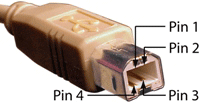
The square-ish connector typically found on the device side of a USB cable for larger peripherals like printers, scanners, and audio interfaces.
- Receptacle contact opening: 8.45 mm (W) × 7.78 mm (H)
- External housing: Approximately 12 mm (W) × 11 mm (H) including shielding
- Pins: 4 contacts (USB 2.0) or 9 contacts (USB 3.0)
- Standards: USB 1.1, 2.0, 3.0
Mini-USB Type-A and Type-B
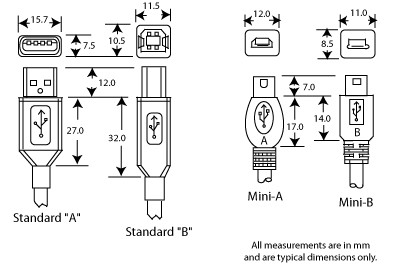
Introduced in 2000 for early mobile devices. Mini-USB has been largely replaced by Micro-USB and then USB-C, but is still found on legacy equipment such as older cameras and MP3 players.
- Mini-A receptacle contact opening: 6.85 mm (W) × 1.8 mm (H)
- Mini-B receptacle contact opening: 6.85 mm (W) × 3.0 mm (H)
- Pins: 5 contacts
- Standards: USB 1.1, 2.0
- Identification: Mini-A insulator is white, Mini-B is black, Mini-AB receptacle is grey
Micro-USB Type-A and Type-B
Introduced in 2007 as the replacement for Mini-USB. Became the universal standard for Android phones and accessories until USB-C took over from around 2017. Micro-USB Type-B is by far the more common variant. Micro-USB Type-A is rare in practice.
- Micro-A and Micro-B receptacle contact opening: 6.85 mm (W) × 1.8 mm (H)
- Pins: 5 contacts
- Standards: USB 2.0
- Distinguishing feature: Micro-USB has a trapezoidal shape with two latching tabs, making it more durable than Mini-USB
Micro-USB 3.0 Type-B
An expanded version of Micro-USB Type-B used on USB 3.0 external hard drives and similar high-speed devices. The connector is essentially Micro-USB Type-B with an additional 5-pin section for SuperSpeed signalling.
- Receptacle contact opening: 12.25 mm (W) × 2.45 mm (H)
- Pins: 10 contacts
- Standards: USB 3.0, 3.1 Gen 1
- Backward compatible: A standard Micro-USB Type-B plug fits the USB 2.0 portion of the receptacle for fallback compatibility
USB Type-C
The current dominant USB connector. Reversible, supports all modern USB speeds, and supports Power Delivery up to 240W. Used on virtually all modern phones, laptops, tablets, and an increasing range of professional AV equipment.
- Receptacle contact opening: 8.34 mm (W) × 2.56 mm (H)
- External plug body: Approximately 8.4 mm × 2.6 mm
- Plug insertion length: Approximately 6.65 mm
- Pins: 24 contacts (12 + 12 in symmetrical layout)
- Standards: USB 2.0, 3.1, 3.2, USB4, Thunderbolt 3/4
- Distinguishing feature: Reversible (works either way up), oval-shaped with rounded ends
Panel cutout dimensions
For panel-mount USB connectors, the cutout dimensions in the panel are typically slightly larger than the receptacle housing to allow for tolerance and mounting hardware. As a general rule, allow 0.2 to 0.5 mm clearance per side. Always refer to the manufacturer's datasheet for the specific connector being installed, as cutout requirements vary between manufacturers and connector styles (right-angle PCB mount, panel mount with flange, panel mount with locking nut, etc.).
Frequently asked questions
What size is a USB-A port?
A standard USB Type-A receptacle has a contact opening of 12.0 mm wide by 4.5 mm high. The full external housing is approximately 14 mm wide by 7 mm high to allow for shielding and mounting tabs.
What size is a USB-C port?
A USB Type-C receptacle has a contact opening of 8.34 mm wide by 2.56 mm high. The connector is symmetrical and reversible, so it works either way up.
What's the difference in size between USB-A and USB-C?
USB-A is wider (12.0 mm vs 8.34 mm) but USB-C is significantly slimmer in height (2.56 mm vs 4.5 mm). USB-C is also symmetrical and reversible, while USB-A only fits one way up.
Are Mini-USB and Micro-USB the same size?
Both have the same width (6.85 mm) but Micro-USB is slimmer (1.8 mm vs 3.0 mm for Mini-B). They are not physically interchangeable. Micro-USB is also more durable due to its different latching design.
What size is a Micro-USB port?
A standard Micro-USB Type-B receptacle has a contact opening of 6.85 mm wide by 1.8 mm high. Micro-USB 3.0 Type-B (used on external hard drives) is wider at 12.25 mm by 2.45 mm.
What's the smallest USB connector?
USB Type-C and Micro-USB are both very small, but Micro-USB has a smaller height (1.8 mm vs 2.56 mm for USB-C). USB-C is wider but offers far more functionality including reversibility, higher speeds, and higher power.
Can I tell USB versions apart by the connector size?
Generally no. The connector dimensions are the same regardless of USB version. A USB-A plug for USB 1.1 is the same size as one for USB 3.2. Internal pin count differs (4 pins for USB 2.0, 9 pins for USB 3.0 and later) but the external housing is unchanged. USB 3.0 and later ports are sometimes coloured blue inside but this is not mandatory.
Additional reference material
For visual identification of USB connectors, see our USB Pinouts and Wiring guide and AV Connector Types guide.
Need USB cables or panel-mount connectors? Browse our USB cables and hubs range or talk to an expert for custom assemblies built to your exact specifications.
Your Project, Perfected. That's The Access Advantage.
- Expert Local Support, Since 1973: Don't waste time with guesswork. Our experts have seen it all and are ready to provide the right solution, right now. Your success is our business.
- Your Specs, Your Brand, Our Build: Off-the-shelf not cutting it? We specialise in building custom cables and assemblies to your exact specifications, branded for your business. Let's create it together.
- Guaranteed for Life: Buy it once. Trust it forever. Our products are backed by a limited lifetime warranty, so you can invest in quality with zero risk. *Warranty excludes third-party brands such as HALO and UPS.
Let's get your project started.
Talk to an expert today for a custom quote or browse the solutions most relevant to your search.