
Wiring, Colours and Pin Dimensions Explained
Quick answer
- Australia uses a 3-flat-pin plug rated at 230V AC, 50Hz, standardised as AS/NZS 3112, the only plug type legally accepted here.
- All compliant plugs sold since April 2005 must have partially insulated Active and Neutral pins.
- Access Communications stocks power cords and adaptors that meet AS/NZS 3112 and carry RCM certification.
This guide covers the wiring configuration, wire colour codes, pin dimensions, plug history, and everything else you need to work confidently with Australian mains plugs.
Guide Index
- Wiring Configuration & Diagrams
- Wire Colour Codes
- Pin Dimensions
- Active vs Neutral: How to Tell Which is Which
- History of the Australian Plug
- Australia vs China vs Argentina: Why They Look the Same But Aren't
- Plug Variants
- Frequently Asked Questions
Wiring Configuration & Diagrams
The standard domestic mains power supply in Australia is nominally 230V AC, 50Hz. Standard 3-pin earthed power outlets are rated at 10A and are almost always switched. The 3-flat-pin design, standardised as AS/NZS 3112, is used throughout Australia, New Zealand, Papua New Guinea, Fiji, Tonga, and the Solomon Islands.
The diagram below shows the standard Australian plug face pinout.

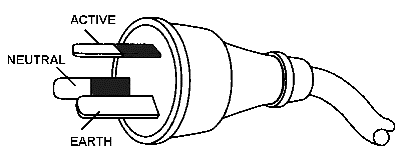
When viewing the plug from the face with the Earth pin at the bottom, the top-right pin is Active (Live) and the top-left pin is Neutral.
Plug & Socket Wiring Diagrams
Note the reversal of Active and Neutral wires depending on whether you are wiring a socket or a plug. This is a common point of confusion.
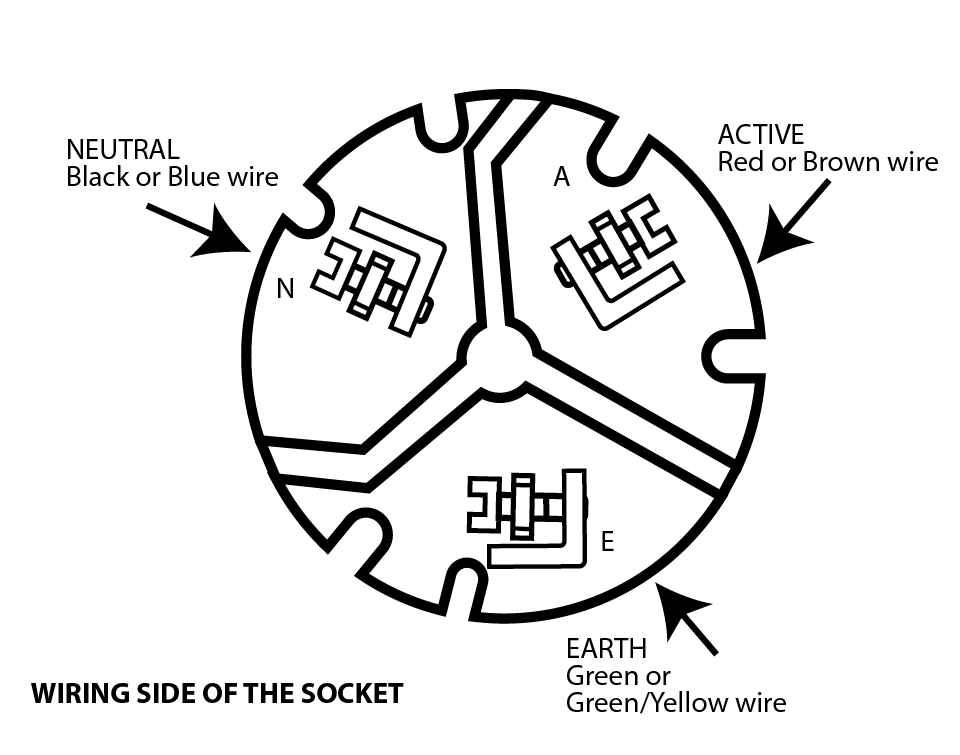
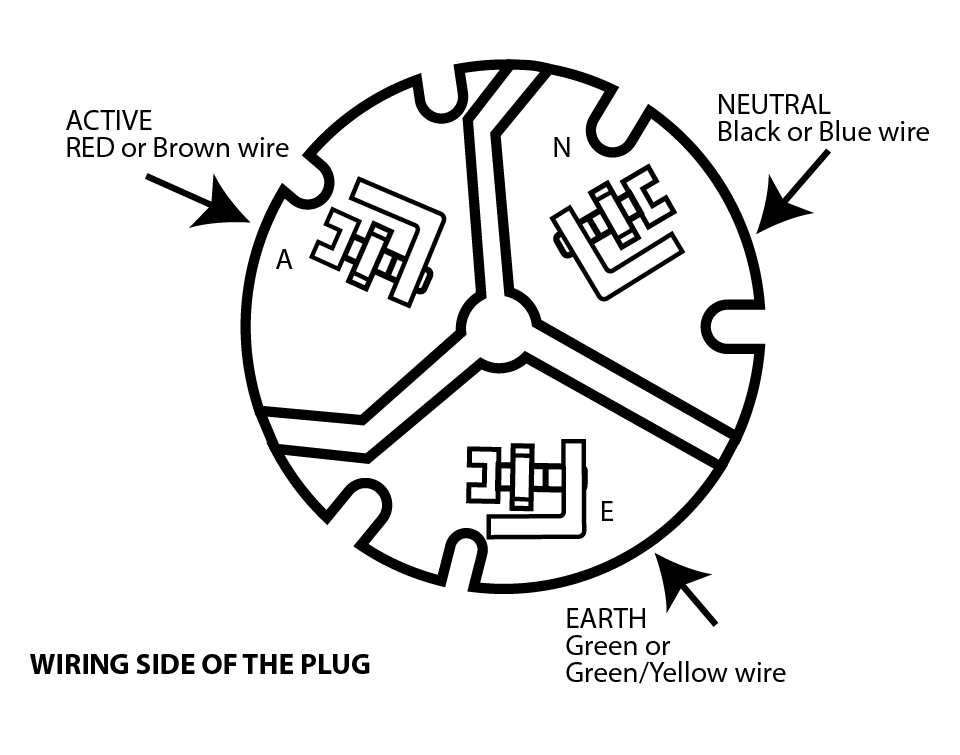
All fixed wiring work must be performed by a licensed electrician under Australian law. Rewireable plug tops can be installed by a competent person, but if in doubt, engage a licensed electrician.
Wire Colour Codes
Australian wire colours changed in 2004 to align with the IEC harmonised colour standard for flexible cords. Both old and new colours remain in service across existing installations, so it is important to recognise both.
| Connection | Terminal Marking | Current Colour: Flexible Cord | Current Colour: Fixed Building Wiring | Old Colour (Pre-2004) |
|---|---|---|---|---|
| Active (Live) | A | Brown | Red | Red |
| Neutral | N | Blue | Black | Black |
| Earth | E | Green/Yellow stripe | Green/Yellow stripe | Green (solid) |
Important: In fixed building wiring, Black still means Neutral under current Australian standards. This differs from the UK and European convention where Black indicates a switched Active conductor. Always verify before working on any circuit.
Pin Dimensions
AS/NZS 3112 specifies exact pin dimensions for the standard 10A plug. These are critical when selecting replacement plugs or verifying compliance.
| Pin | Width | Thickness | Length | Angle | Distance from Centre |
|---|---|---|---|---|---|
| Active | 6.35mm | 1.6mm | 17.35mm | 30° to vertical | 7.92mm |
| Neutral | 6.35mm | 1.6mm | 17.35mm | 30° to vertical | 7.92mm |
| Earth | 6.35mm | 1.6mm | 20mm | Vertical | 10.31mm |
The Earth pin is always longer than the Active and Neutral pins. This ensures the earth connection is made first on insertion and broken last on removal, providing continuous protection throughout the connection cycle.
The Active and Neutral pins are arranged at 30° to the vertical, forming the characteristic inverted V-shape. All three pins are arranged at 120° angles around a common midpoint. The pin spacing (centre-to-centre between Active and Neutral) is 13.7mm.
Active vs Neutral: How to Tell Which is Which
When viewing the plug from the face (Earth pin at the bottom):
- Top-right pin = Active (marked A)
- Top-left pin = Neutral (marked N)
- Bottom-centre pin = Earth (marked E)
On the socket (viewing from the front), the positions are mirrored: top-left is Active and top-right is Neutral. This reversal is why the wiring diagrams for plugs and sockets differ, and it is a frequent source of errors when rewiring.
The terminals on quality plug tops are marked A, N, and E. Always follow these markings rather than relying on pin position alone, particularly when working with older or unfamiliar hardware.
History of the Australian Plug
The Australian plug has a longer history than most people realise, and its origins are American rather than British.
The design was patented in 1916 by Harvey Hubbell, an American inventor, under US Patent 1,179,728. The flat pin design was adopted in Australia because the pins could be cheaply stamped out of sheet brass, making them far less expensive to manufacture than the round pins used in British-style plugs at the time.
By the early 1930s, Australian manufacturers had up-rated the design to 250V, 10A capacity. A "gentlemen's agreement" reportedly reached in 1930 between Fred Cook of Ring-Grip, Geoffrey Gerard of Gerard Industries, and Brian Harper Miller of the State Electricity Commission of Victoria aligned the industry on a common standard. The design was provisionally floated as Standard C112 in 1937 and formally adopted in 1938.
The standard was superseded by AS 3112 in 1990, then harmonised with New Zealand as AS/NZS 3112. The major 2000 revision (AS/NZS 3112:2000) introduced the requirement for insulated Active and Neutral pins, enforced from 3 April 2005. The 2004 revision (AS/NZS 3112:2004) added more stringent pin bending tests. The current version is AS/NZS 3112:2017.
Australia vs China vs Argentina: Why They Look the Same But Aren't
Several countries use a Type I plug that looks almost identical to the Australian design but is not legally interchangeable with it.
| Country | Standard | Voltage | Key Differences | Legally Usable in Australia? |
|---|---|---|---|---|
| Australia / NZ | AS/NZS 3112 | 230V | Insulated pins mandatory, Active top-right | Yes |
| China | GB 2099 (CPCS/CCC) | 220V | Pins 1mm longer, no insulation required, socket mounted inverted (earth at top), plug body dimensions may prevent fitting in recessed AU sockets | No |
| Argentina | IRAM 2073 | 220V | Active and Neutral polarity reversed, no insulation required. Using in Australia creates a shock and fire risk. | No |
Products sourced from Chinese or Argentinian manufacturers with non-compliant plugs will be rejected at Australian customs or recalled from market. Always verify RCM certification before importing electrical equipment.
Plug Variants
AS/NZS 3112 defines several variants beyond the standard 10A earthed plug. For a complete guide to all current rating variants including socket compatibility and pin dimensions, see our Australian Mains Plug Variants page. For an explanation of the round vs flat earth pin used on some 10A plugs, see Round & Flat Earth Pin Comparison. For the mandatory insulated pin safety requirement, see Mains Plug Insulated Pins.
Frequently Asked Questions
What voltage does Australia use?
Australia's nominal mains voltage is 230V AC at 50Hz. The transition from 240V was completed nationally by 2022, though equipment rated for 220-240V will operate correctly at 230V without modification.
What is the difference between wiring a plug and wiring a socket?
The Active and Neutral positions are reversed between a plug and a socket. On the plug face (Earth at bottom), Active is top-right and Neutral is top-left. On the socket face, Active is top-left and Neutral is top-right. The wiring terminals on both are marked A and N, so always follow the markings.
What do the Australian wire colours mean?
In flexible cords: Brown = Active, Blue = Neutral, Green/Yellow = Earth. In fixed building wiring: Red = Active, Black = Neutral, Green/Yellow = Earth. Pre-2004 flexible cords used Red (Active), Black (Neutral), and solid Green (Earth).
Why does the Earth pin look different on some plugs?
Most 10A plugs have a flat earth pin for general-purpose outlets. Some 10A plugs have a round earth pin, which is designed for special-purpose circuits such as controlled lighting, exhaust fans, EFTPOS terminals, and IT equipment. The two types are not interchangeable. See our Round & Flat Earth Pin guide for more detail.
What are the insulated pins on modern Australian plugs?
Since April 2005, all plugs sold in Australia must have the lower half of the Active and Neutral pins covered with an insulating sleeve. This prevents electric shock when a plug is partially withdrawn from a socket, which was the cause of several fatalities in Australia prior to the standard change. See our Mains Plug Insulated Pins guide for the full background.
Can I use a Chinese or Argentinian plug in Australia?
No. Although Type I plugs from China and Argentina look almost identical to Australian plugs, they are not legally or safely interchangeable. Chinese plugs have longer pins that may not fit in recessed Australian sockets and are not certified to AS/NZS 3112. Argentinian plugs have the Active and Neutral pins reversed, which creates a shock and fire risk. Only plugs carrying RCM certification to AS/NZS 3112 may be legally sold or used in Australia.
Can I plug a 10A plug into a 15A or 20A socket?
Yes. Lower-rated plugs will fit higher-rated sockets. A standard 10A plug fits 10A, 15A, and 20A flat-earth sockets. The reverse is not true: a 15A or 20A plug will not fit a 10A socket, because the larger earth pin physically prevents it. This design ensures high-current appliances can only connect to appropriately rated circuits.
What is RCM certification?
The RCM (Regulatory Compliance Mark) is the mandatory compliance mark for electrical equipment sold in Australia and New Zealand. It replaces the older C-Tick and A-Tick marks. Any mains-connected product sold in Australia must carry RCM certification, confirming it meets the relevant AS/NZS safety standards.
Why does the Australian plug look similar to the American plug?
The design originated from a US patent filed in 1916 by Harvey Hubbell. Although the 3-pin flat design never became the American standard, Australia adopted it in the 1930s because the flat pins were cheap to stamp from sheet brass. The current Australian plug will actually fit a US outlet, though this is not recommended due to voltage differences (230V vs 120V).
Your Project, Perfected. That's The Access Advantage.
- Expert Local Support, Since 1973: Don't waste time with guesswork. Our experts have seen it all and are ready to provide the right solution, right now. Your success is our business.
- Your Specs, Your Brand, Our Build: Off-the-shelf not cutting it? We specialise in building custom cables and assemblies to your exact specifications, branded for your business. Let's create it together.
- Guaranteed for Life: Buy it once. Trust it forever. Our products are backed by a limited lifetime warranty, so you can invest in quality with zero risk. *Warranty excludes third-party brands such as HALO and UPS.
Let's get your project started.
Talk to an expert today for a custom quote or browse the solutions most relevant to your search.