
A Guide to Low-Voltage DC Output Plugs
Quick answer
- Always confirm polarity before connecting, reversed polarity is not covered by warranty and can permanently damage equipment.
- The 2.1mm and 2.5mm barrel plug IDs are easily confused, measure with callipers rather than guessing by eye.
- Access Communications stocks DC plugs, cables, and power supplies across every common size and polarity.
Low-voltage DC power supplies use a wide variety of output plugs. Identifying the correct plug type, size, and polarity is essential for a safe and reliable connection. Using the wrong size causes intermittent power or no connection. Using the wrong polarity can permanently damage the device being powered. This guide provides a visual reference and practical identification guide for the most common DC output plugs found in consumer and professional electronics.
Guide Index
- Polarity: Getting It Right Before You Connect
- Concentric Barrel Plugs & EIAJ Plugs
- 3-Pin and 4-Pin Locking DC Plugs
- DIN and Mini-DIN Plugs
- Phono & RCA Plugs
- Modular & Mini IEC Plugs
- Troubleshooting Intermittent DC Connections
Polarity: Getting It Right Before You Connect
Before connecting any DC power supply, confirm the polarity. Reversed polarity is the most common cause of damage to low-voltage equipment and is not covered by warranty on most devices.
Polarity on a barrel connector is described as either centre positive or centre negative.
- Centre positive (most common): The centre pin (tip) of the barrel plug is the positive (+) conductor. The outer sleeve is negative (-) or ground. The vast majority of consumer electronics, routers, access points, CCTV cameras, and networking equipment use centre positive.
- Centre negative (less common): The centre pin is negative (-) and the outer sleeve is positive (+). Some older audio equipment and certain specialist devices use this configuration.
The polarity diagram is printed on the power supply label, usually near the output voltage and current rating. It looks like a circle with a dot in the centre (representing the tip) and a larger arc (representing the sleeve), with + and - symbols indicating which is which. Always check this diagram before connecting a replacement power supply.
If the label is missing or unreadable, use a multimeter set to DC voltage. Place the red probe inside the barrel tip and the black probe against the outer sleeve. A positive reading confirms centre positive. A negative reading confirms centre negative.
Concentric Barrel Plugs & EIAJ Plugs
Concentric Barrel Plugs (Standard DC Plugs)
Barrel plugs are the most common DC output connector in consumer and professional electronics. They are described by three dimensions: outer diameter (OD), inner diameter (ID), and barrel length. Getting the ID right is critical. A plug with an ID that is too small will not fit the jack. A plug with an ID that is too large will fit but make intermittent contact, causing power dropouts or equipment damage.
The 2.1mm and 2.5mm ID versions are very easily confused. Both share a 5.5mm OD and look almost identical. When in doubt, measure with a calliper rather than guessing by eye.
| Outside Dia. (OD) | Inside Dia. (ID) | Length | Common Applications | Diagram |
|---|---|---|---|---|
| 5.5mm | 2.5mm | 8–14mm | CCTV cameras, some routers, older laptop supplies | 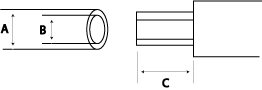 |
| 5.5mm | 2.1mm | 8–14mm | Most common size. Networking equipment, CCTV, LED drivers, power supplies | |
| 5.0mm | 2.1mm | 8–14mm | Some laptop power supplies and consumer electronics | |
| 3.8mm | 1.35mm | 8–14mm | Smaller consumer electronics, some portable devices | |
| 3.5mm | 1.35mm | 7–14mm | Small consumer electronics, some audio equipment |
EIAJ RC-5320A Plugs (Voltage-Coded)
Developed by the Electronics Industries Association of Japan, EIAJ plugs look similar to barrel plugs but have a distinctive yellow insulating ring at the base. They are coded by voltage class, meaning each size corresponds to a specific voltage range, reducing the risk of connecting the wrong power supply to a device. EIAJ plugs are always centre positive.
| Model | Voltage Class | OD | ID / Pin | Diagram |
|---|---|---|---|---|
| EIAJ-01 | Class 1 (3.15V) | 2.4mm | 0.7mm | 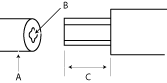 |
| EIAJ-02 | Class 2 (6.30V) | 4.0mm | 1.7mm | |
| EIAJ-03 | Class 3 (10.50V) | 4.8mm | 1.7mm | |
| EIAJ-04 | Class 4 (13.5V) | 5.5mm | 1.0mm pin | 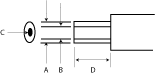 |
| EIAJ-05 | Class 5 (18.0V) | 6.5mm | 1.4mm pin |
3-Pin and 4-Pin Locking DC Plugs
These plugs are used on multi-output low-voltage power supplies. They resemble Mini-DIN plugs but have larger diameter pins capable of carrying greater current. The locking mechanism ensures the connection cannot be accidentally disconnected, making them common in security, CCTV, and access control installations.
| Model | OD | Length | Diagram |
|---|---|---|---|
| 3-Pin | 10mm | 6mm |  |
| 4-Pin | 10mm | 6mm |
DIN and Mini-DIN Plugs
DIN is an acronym for Deutsche Industrie Norm, the German standards organisation responsible for industrial product standards. Circular DIN plugs are available in 3 to 14 pins. The 5-pin version is available in either a 180° or 240° pin layout. Mini-DIN plugs are smaller at 9.5mm in diameter and are keyed to prevent incorrect insertion. Both types appear as power connectors on older keyboards, MIDI equipment, and some specialised industrial devices.
| Type | OD | Pins | Diagram |
|---|---|---|---|
| DIN | 13.2mm | 3 to 8 pins | 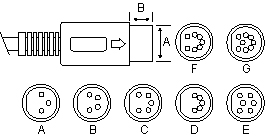 |
| Mini-DIN | 9.5mm | 3 to 8 pins | 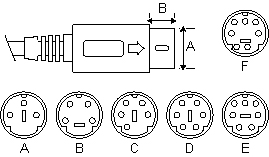 |
Phono & RCA Plugs
Phono Plugs (TRS/TS)
Phono plugs come in three diameters: 6.3mm (1/4"), 3.5mm (1/8"), and 2.5mm (1/16"). Each diameter is available in mono (2-pole, TS: Tip and Sleeve) and stereo (3-pole, TRS: Tip, Ring, and Sleeve) versions. Although primarily audio connectors, phono plugs appear as power outputs on some specialist equipment and older consumer devices.
| Type | Sizes | Diagram |
|---|---|---|
| Mono (TS) | 2.5mm, 3.5mm, 6.3mm | 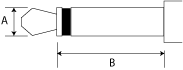 |
| Stereo (TRS) | 2.5mm, 3.5mm, 6.3mm | 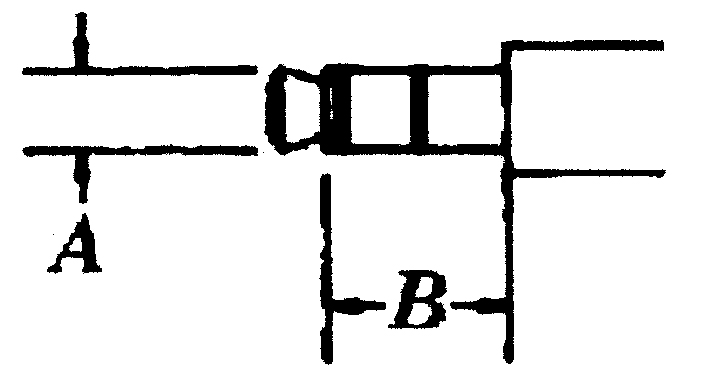 |
RCA Plugs
A coaxial plug most commonly used for audio and video connections, but occasionally used as a power output on devices such as TV antenna power injectors. RCA plugs used for DC power are always wired centre positive: the centre pin is positive (+) and the outer shield is negative (ground).
| Pin Diameter | Outer Diameter | Diagram |
|---|---|---|
| 3.70mm | 8.25mm |  |
Modular & Mini IEC Plugs
Modular Plugs (RJ Plugs)
Although originally designed for telephony and data, modular plugs are used as power output connectors on some low-voltage equipment. Available in 4, 6, 8, and 10 position configurations. View our range at Modular Plugs & Sockets.
| Model | Availability | Diagram |
|---|---|---|
| 4, 6, 8, 10 Position | View Products |  |
Mini IEC Plugs
A 3-pin miniature output plug used by devices such as EFTPOS terminals that require higher currents at low voltage. Named a mini IEC plug because its shape resembles the larger IEC C13 connector used for mains voltage equipment, though it operates at DC low voltage only and the two are not electrically compatible.
| Pins | Dimensions (A, B, C) | Diagram |
|---|---|---|
| 3 | 13.0mm, 9.0mm, 8.0mm | 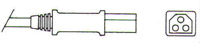 |
Troubleshooting Intermittent DC Connections
Intermittent power, random dropouts, or equipment that powers on briefly then cuts out are almost always caused by one of four things.
- Wrong ID on a barrel plug: A plug with an ID slightly larger than the jack will fit but not make reliable contact. The 2.1mm and 2.5mm versions of the 5.5mm OD barrel plug are the most common culprit. Swap to the correct ID and the problem resolves immediately.
- Barrel length too short: Some jacks require a longer barrel (12mm+) to make full contact. If the plug fits but power is intermittent, try a longer barrel version of the same OD/ID.
- Wrong polarity: Reversed polarity may power the device partially or cause it to behave erratically before protection circuits cut in. Confirm polarity with a multimeter before replacing equipment.
- Undersized power supply: A supply rated below the device's actual current draw will cause dropouts under load. Check the device's nameplate current rating and ensure the replacement supply meets or exceeds it.
Your Project, Perfected. That's The Access Advantage.
- Expert Local Support, Since 1973: Don't waste time with guesswork. Our experts have seen it all and are ready to provide the right solution, right now. Your success is our business.
- Your Specs, Your Brand, Our Build: Off-the-shelf not cutting it? We specialise in building custom cables and assemblies to your exact specifications, branded for your business. Let's create it together.
- Guaranteed for Life: Buy it once. Trust it forever. Our products are backed by a limited lifetime warranty, so you can invest in quality with zero risk. *Warranty excludes third-party brands such as HALO and UPS.
Let's get your project started.
Talk to an expert today for a custom quote or browse the solutions most relevant to your search.