
How to tell Cat5, Cat6 and Cat6A apart
Quick answer
- Cat5/Cat5e plugs have all eight wires in a single row. Cat6 and Cat6A plugs have them staggered in two rows.
- The lowest-rated component in a link sets the whole link's performance, always match plug rating to cable rating.
- Access Communications stocks Cat5e, Cat6, and Cat6A plugs to match every cable rating.
Knowing whether the cable or plug you're looking at is Cat5e, Cat6 or Cat6A is one of the most common questions in any data cabling job, and it's surprisingly easy to get wrong. The wrong combination silently downgrades a whole network link to the slowest component in the chain, which is the number one cause of "the cable was Cat6 but the speed is only 100 Mbps" callbacks. This guide covers fast visual identification for plugs and cables, the spec differences that matter, and how to avoid the common mismatches that cost installers time and money.
The 30-second identification check
If you're on site with no markings to read, these three checks tell you almost everything you need to know in 30 seconds.
- Read the cable jacket. Every legitimate Cat-rated cable has the category printed along the jacket, alongside other markings like the AWG, the standard, and the manufacturer. "Cat5e", "Cat6", "Cat6A" or "Category 6" will be there. If you can't see it, slide a few metres along the cable, it repeats at regular intervals.
- Look inside the plug. An RJ45 plug is clear plastic for exactly this reason. Cat5/Cat5e plugs have all eight wires in a single straight row. Cat6 plugs have them staggered in two rows. Cat6A plugs are staggered too, but with a noticeably bulkier body to accommodate the thicker conductors and tighter twist tolerances.
- Look at the cable cross-section. Cut a small section of jacket and look at the cable end-on. Cat5e has four loose pairs with nothing between them. Cat6 typically has a plastic cross-shaped spline (also called a cross-web or divider) running down the centre to keep the pairs separated. Cat6A often has even more structure, including individual pair shields in some variants.
If all three checks agree, you have your answer. If they disagree (for example, a plug that looks Cat5 on a cable marked Cat6), the lowest-rated component wins, and your link will only perform at that lower spec.
Cat5 / Cat5e plug
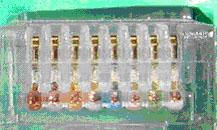
A Cat5 or Cat5e plug always has all eight conductors in a single straight row. The plug body is slimmer than Cat6 because the thinner 24 AWG conductors fit side by side without needing organisation. Cat5e plugs do not need a load bar.
Cat5 (the original 1995 standard) is effectively obsolete for new installations. Cat5e ("enhanced") uses the same physical plug but with tighter performance specifications to support Gigabit Ethernet. For practical purposes, any plug being sold today as "Cat5" is actually Cat5e.
Cat6 plug
A Cat6 plug has the eight conductors staggered in two rows. The staggered layout increases the physical separation between wire pairs at the termination, reducing near-end crosstalk (NEXT) to meet Cat6's higher 250 MHz bandwidth specification. Cat6 plugs almost always require a load bar to organise the conductors before they enter the plug body. For step-by-step Cat6 termination instructions, see our Cat6 termination guide.
Staggered 4 over 4 layout
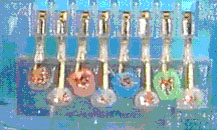
The majority of Cat6 plugs sold in Australia use this layout: four conductors in the upper row, four in the lower row. The Access P2176UB Cat6 plug uses this design.
Staggered 6 over 2 layout
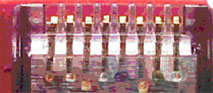
A less common variant places six conductors in the upper row and two in the lower. The crosstalk performance is equivalent to the 4-over-4 layout, the design is simply a different mechanical approach. Both are valid Cat6 plugs.
Cat6A plug
A Cat6A plug uses the same staggered conductor layout as a Cat6 plug, but with tighter manufacturing tolerances to handle the higher 500 MHz bandwidth required for 10 Gigabit Ethernet over the full 100 metre run length. Cat6A plugs have a noticeably bulkier body than Cat6, particularly the shielded variants that include drain wire contact for shielding continuity.
For shielded Cat6A installations (Cat6A F/UTP or S/FTP), the plug needs a metal shield housing that bonds to the cable's drain wire or foil. The Access P2178FT field-termination plug is designed for this.
A Cat6 plug will physically fit on Cat6A cable but is unlikely to meet Cat6A performance because of the tighter tolerances. A Cat6A plug works on Cat6 cable but downgrades the link to Cat6 spec. Always match the plug rating to the cable rating.
Identifying the cable, not just the plug
If you can't see the plug clearly, or the plug is already terminated and you can't take it apart, the cable itself is your best clue. Three visible features give you a high-confidence identification.
| Feature | Cat5e | Cat6 | Cat6A |
|---|---|---|---|
| Outer diameter | 5.0-5.5 mm | 6.0-6.5 mm | 7.0-8.5 mm |
| Conductor gauge | 24 AWG | 23 AWG | 23 AWG |
| Internal spline | None | Plastic cross-web divider | Spline plus optional shielding |
| Twist tightness | Looser pairs | Tighter, especially orange and blue pairs | Tightest, often with individual pair shields |
| Jacket marking | "Cat5e" or "Category 5e" | "Cat6" or "Category 6" | "Cat6A" or "Category 6A" |
| Flexibility | Most flexible | Stiffer due to spline | Stiffest, hardest to pull |
Why mixing plugs and cable downgrades the link
The performance of any structured cabling link is set by the lowest-rated component in the chain. This is the single most important reason to match plug to cable and avoid mixing categories.
If you run Cat6 cable but terminate it with Cat5e plugs, the link is now a Cat5e link. The cable's thicker conductors, tighter twist, and spline are irrelevant if the termination can't preserve the signal characteristics. Crosstalk and return loss at the plug end will fail Cat6 testing, and the link will only certify to Cat5e performance.
The reverse is also true. Cat6 plugs on Cat5e cable physically work, but the thinner Cat5e conductors will not fill the Cat6 plug correctly, the crimp may be unreliable, and you've gained no performance benefit because the cable itself caps the link at Cat5e.
Match plugs to cable. Match keystones to cable. Match patch panels to cable. Every component in a single link should be rated for the same category, and ideally from a manufacturer that has performance-tested its components together as a system.
Quick comparison: Cat5e vs Cat6 vs Cat6A
| Specification | Cat5e | Cat6 | Cat6A |
|---|---|---|---|
| Bandwidth | 100 MHz | 250 MHz | 500 MHz |
| Max speed (100m) | 1 Gbps | 1 Gbps (10 Gbps to 55m) | 10 Gbps |
| Plug wire layout | Single straight row | Staggered two rows (4x4 or 6x2) | Staggered two rows, bulkier body |
| Load bar required | No | Yes | Yes (or tool-less alternative) |
| Backward compatibility | Cat5 | Cat5e | Cat6, Cat5e |
| Australian standard | Class D | Class E | Class Ea |
For a fuller breakdown of every Ethernet category from Cat1 to Cat8, see our reference guide for category standards. For practical guidance on when Cat6A is worth the cost premium over Cat6, see our Cat6 vs Cat6A guide.
Common identification mistakes
- Trusting the patch lead's connector to identify the cable. Pre-made patch leads sometimes use Cat6 plugs on Cat5e cable (or vice versa) because manufacturers mix and match for cost. Always identify the cable itself.
- Assuming all Cat6 plugs are staggered 4 over 4. The 6 over 2 layout is also a valid Cat6 plug. The presence of staggering is what matters, not the specific arrangement.
- Confusing thick jackets with high category. Some Cat5e cables (especially outdoor or armoured variants) are thicker than indoor Cat6. Diameter alone is not definitive, check the markings and internal structure.
- Mistaking shielded Cat5e for Cat6A. Both have a foil or braided shield. The distinguishing features are the conductor gauge (24 AWG for Cat5e vs 23 AWG for Cat6A) and the jacket marking.
- Ignoring the printed text on assumed-old cable. Even cable that looks old usually has its category printed somewhere. Run your fingers along it until you find a clear section, the markings repeat every metre or so.
Frequently asked questions
How can I tell Cat5 from Cat6 quickly?
The fastest visual check is the plug: Cat5/Cat5e has all eight conductors in a single row, Cat6 has them staggered in two rows. If you can read the cable jacket, the category will be printed along the cable, repeated at regular intervals. Cat6 cable is also slightly thicker than Cat5e and usually has a plastic spline dividing the pairs inside.
What's the difference between Cat5 and Cat5e?
Cat5e (enhanced) uses the same physical connector and conductors as the original 1995 Cat5 standard, but with tighter performance specifications that support Gigabit Ethernet. Original Cat5 was rated for 100 Mbps. For practical purposes, Cat5 is obsolete and Cat5e is the minimum standard for any new installation today.
Can I use Cat5e plugs on Cat6 cable?
Physically yes, but you'll downgrade the entire link to Cat5e performance. The point of paying for Cat6 cable is the higher specification, which Cat5e plugs cannot preserve at the termination point. Always match plug rating to cable rating.
Can I use Cat6 plugs on Cat5e cable?
The plug will fit, but the thinner Cat5e conductors may not crimp securely inside the Cat6 plug, and the cable itself caps the link at Cat5e performance. There's no benefit to the mismatch, only added cost and potential reliability issues. Use Cat5e plugs on Cat5e cable.
Why do Cat6 plugs have a staggered wire layout?
Crosstalk reduction. The staggered arrangement physically separates the four pairs at the termination point, which is essential for meeting Cat6's 250 MHz bandwidth specification. A single-row Cat5e plug cannot achieve this separation.
Do all Cat6 plugs need a load bar?
Standard 2-piece Cat6 plugs require a load bar to organise the conductors into the staggered layout before insertion. Tool-less Cat6 plugs (such as the Access P2176QT Quick Term family) use a different internal mechanism that achieves the same result without a separate load bar component. Either approach meets Cat6 performance when correctly terminated.
What about Cat6A plugs?
Cat6A plugs use the same staggered layout as Cat6 but with tighter manufacturing tolerances to handle the higher 500 MHz bandwidth. The plug body is bulkier, particularly for shielded variants that include drain wire contact. A Cat6 plug fits on Cat6A cable but won't meet Cat6A performance. A Cat6A plug works on Cat6 cable but downgrades the link to Cat6 spec.
How do I know if my existing plugs are Cat5 or Cat6 without taking them apart?
The plug body is clear plastic specifically so you can see the conductor layout inside. Hold the plug up to a light source and look at the contacts from the side. Cat5e shows a single row of eight conductors. Cat6 shows the staggered two-row arrangement. A magnifier helps if your eyes can't pick it up clearly.
What's the standard Ethernet cable for new Australian commercial installs?
Cat6 is the minimum standard for most new commercial fitouts. Cat6A is increasingly specified for new construction, particularly for areas supporting PoE++ devices, high-density Wi-Fi access points, and data centre patching. Cat5e remains acceptable for residential and small-office work but is rarely specified for new commercial cabling today.
Your Project, Perfected. That's The Access Advantage.
- Expert Local Support, Since 1973: Don't waste time with guesswork. Our experts have seen it all and are ready to provide the right solution, right now. Your success is our business.
- Your Specs, Your Brand, Our Build: Off-the-shelf not cutting it? We specialise in building custom cables and assemblies to your exact specifications, branded for your business. Let's create it together.
- Guaranteed for Life: Buy it once. Trust it forever. Our products are backed by a limited lifetime warranty, so you can invest in quality with zero risk. *Warranty excludes third-party brands such as HALO and UPS.
Let's get your project started.
Talk to an expert today for a custom quote or browse the solutions most relevant to your search.