
Three standards, one cord
Quick answer
- A cord with different ratings on each end, like a 10A plug feeding a C19 inlet, isn't a mistake, three separate standards govern the mains plug, the equipment connector, and the flex cable.
- The mains end sets the actual current limit, the IEC connector rating is a ceiling, not a demand.
- Access Communications stocks power cords with full RCM certification across the mains plug, IEC connector, and flex cable.
A cord with a 10A mains plug on one end and a 16A-rated C19 connector on the other isn't a mistake, and it isn't a compliance loophole. A power cord actually answers to three separate standards at once, one for the mains plug, one for the equipment connector, and one for the flex cable running between them, each doing a different job. Once you see the split, the confusion mostly disappears.
Guide Index
- The Three Standards at a Glance
- AS/NZS 3112: The Mains End
- IEC 60320: The Equipment End
- AS/NZS 3191: The Flex Itself
- Which End Actually Governs the Cord
- Real-World Examples
- Common Pairings, Compared
- The One Pairing That Is Genuinely a Problem
- Where Suppliers and Installers Get This Wrong
- Reading a Cord's Label for Yourself
- How to Check Any Cord Yourself
- Frequently Asked Questions
The Three Standards at a Glance
| Standard | Governs | Common Ratings | Compliance Mark |
|---|---|---|---|
| AS/NZS 3112 | Mains plug and wall socket, physical fit, current from the wall circuit | 10A, 15A, 20A, 25A, 32A | RCM |
| IEC 60320 | Equipment connector, the shape that mates with the device | C13/C14 (10A), C19/C20 (16A) | RCM |
| AS/NZS 3191 | The flex cable itself, construction, insulation, and current-carrying capacity | Rated by voltage class and current | RCM |
A single detachable power cord typically carries all three standards at once, two governing the ends, one governing the cable running between them. That's normal, not a red flag.
AS/NZS 3112: The Mains End
AS/NZS 3112 is the Australian and New Zealand standard for domestic wall plugs and sockets. It governs physical fit and what a wall circuit can safely deliver, nothing about the equipment at the other end of the cord.
- 10A plug: two flat pins, standard-width earth pin, matching the active and neutral pins. Fits both 10A and 15A wall sockets.
- 15A plug: wider earth pin, a deliberate design feature that physically prevents it fitting a standard 10A socket.
- 20A, 25A, 32A plugs: further pin variations for heavier industrial loads, rarely seen outside dedicated circuits.
See our full Australian Mains Plug Variants guide for the complete breakdown of every current-rated plug type.
IEC 60320: The Equipment End
IEC 60320 is an international standard for appliance couplers, letting a manufacturer build one universal device and simply swap the country-specific mains cable depending on where it's sold.
| Pair | Rating | Width x Height | Common Use | Diagram |
|---|---|---|---|---|
| C13/C14 | 10A, 70°C | 29.0mm x 20.8mm | PCs, monitors, switches, general IT |  |
| C19/C20 | 16A, 70°C | 44.0mm x 24.0mm | Servers, PDUs, UPS units, rack equipment |  |
See our full Guide to IEC Connectors for the complete connector reference table, dimensions, and compatibility rules.
AS/NZS 3191: The Flex Itself
AS/NZS 3191 governs the flexible cord itself, the cable running between the mains plug and the equipment connector, not either end. It specifies construction, insulation material, dimensions, and testing for the cord, a genuinely separate compliance category from both connector standards.
This means a cord can have a fully compliant mains plug and a fully compliant IEC connector, and still be missing valid certification for the flex joining them. Imported cable built to overseas standards is a common example, a US UL-listed cord may be electrically sound but isn't automatically compliant here without AS/NZS 3191 certification or a recognised harmonised equivalent.
Which End Actually Governs the Cord
The mains end is wired directly into your wall circuit and its breaker. That's what genuinely limits the current the whole cord can carry, current is drawn by the load, never forced by whatever's rated higher at the other end. The IEC connector is simply the physical shape that mates with the equipment, its rating is a ceiling, not a demand.
This is why many UPS units and PDUs are built with a standardised C19/C20 inlet regardless of how much current the specific unit actually draws, and why a 10A or 15A mains plug feeding that inlet is completely normal.
The flex cord's own certification under AS/NZS 3191 is a separate question entirely, it's about the cable's construction and insulation, not about which end limits the current.
Real-World Examples
A small rack-mount UPS. Many 1 to 3kVA UPS units are built with a standardised C19 or C20 inlet, even though the unit itself might only draw 6 to 8 amps under real load. The C19 inlet is there because it's the industry-standard connector for that class of equipment, not because the unit needs 16 amps. The mains plug feeding it, 10A or 15A, is what actually limits the current, and it's set correctly for what the unit really draws.
A PDU feeding a rack of switches. A rack PDU often has a C20 inlet at the wall end and a bank of C13 outlets along its length. The C20 inlet lets the PDU accept a heavier-duty incoming supply if the rack's total load calls for it, while each individual C13 outlet only ever supplies what the device plugged into it actually draws.
A network switch or server with a standard IEC inlet. Most general IT equipment uses a C14 inlet, rated 10A, paired with a standard 10A mains plug. Since both ends match, this is the simplest and most common cord type, and it's the one least likely to raise any questions at all.
Common Pairings, Compared
| Mains End | Connector End | Governing Rating | Verdict |
|---|---|---|---|
| 15A mains plug | C19 (16A) | 15A | Normal, compliant |
| 10A mains plug | C19 (16A) | 10A | Normal, compliant |
| 10A mains plug | C13 (10A) | 10A | Standard, everyday cord |
| C13/C14 forced onto C19/C20 via adapter | Mismatched families | Undefined | Avoid |
The One Pairing That Is Genuinely a Problem
C13/C14 and C19/C20 are physically shaped so they cannot connect to each other directly, deliberately, to stop a 10A-rated connector being forced onto a 16A-rated one. At 29.0mm by 20.8mm, C13/C14 is a noticeably smaller connector body than C19/C20 at 44.0mm by 24.0mm, the size difference is intentional, not incidental. A C13 cord will not fit a C20 inlet, and a C19 cord will not fit a C14 inlet.
The real risk shows up when an adapter overrides that protection. Forcing these two connector families together typically limits the whole assembly to the lower connector's rating regardless of what the adapter is marked as, and can result in poor contact, overheating, or fire.
Where Suppliers and Installers Get This Wrong
Assuming a mismatch means a mistake. The most common error is treating any two-different-numbers cord as suspicious. As the comparison table above shows, three of the four common configurations are entirely normal.
Confusing partial certification with full certification. A cord can have a fully compliant mains plug and a fully compliant IEC connector and still be missing valid certification for the flex itself under AS/NZS 3191. All three components, the mains plug, the IEC connector, and the flex cord, need their own valid approval for the finished cord to be genuinely compliant. When sourcing from a new supplier, ask for test documentation covering all three, not just the connector certifications.
Not checking for the RCM mark on all three components. A compliant cord displays it at the mains plug, the IEC connector, and on the flex cable jacket itself. Its absence on any of the three is the detail worth querying, not the fact that the ratings differ.
Assuming a higher-rated connector implies a higher-draw device. A C19 inlet on a UPS or PDU signals that the equipment is built to standard, industry-common specifications, not that the specific unit necessarily draws close to 16A. Checking the equipment's actual rated draw, not just its inlet type, avoids over-speccing a supply cord unnecessarily.
Reading a Cord's Label for Yourself
Most compliant cords print their key details directly on the cable jacket in a repeating strip of text. Look for:
- The manufacturer or brand name
- A reference to the applicable standard (for example, the relevant AS/NZS or IEC standard number)
- The voltage and current rating (for example, "250V 10A")
- The RCM mark, usually a small tick-in-a-triangle symbol
If any of this is missing, worn away, or looks inconsistent with what the connector shapes suggest, that's the detail worth raising with your supplier, not the fact that the two ends of the cord carry different numbers.
How to Check Any Cord Yourself
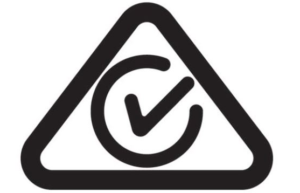
This is the Regulatory Compliance Mark. Any compliant cord displays it on the mains plug, the IEC connector, and the flex cable itself.
- Look for the RCM mark on the mains plug, the IEC connector, and the flex cable jacket.
- Confirm the mains end rating (10A, 15A, etc.) against the wall circuit it will run from.
- Confirm the IEC connector matches the equipment's inlet type (C14 for C13, C20 for C19).
- Confirm the flex cable itself references AS/NZS 3191 or a recognised harmonised equivalent, not just the two connectors.
- If sourcing a new or unusual pairing, ask your supplier for test documentation covering all three components, not just the connector certifications.
For the full detail on what the RCM covers and the two regulatory schemes behind it, see our Product Compliance guide.
Frequently Asked Questions
Is it safe to use a power cord with different ratings on each end?
Yes, provided the pairing follows the pattern in the comparison table above, a mains plug feeding a higher-rated IEC connector. The mains end governs the current the cord can safely carry, regardless of the connector's rating.
Can a C19 connector be adapted to fit a C13/C14 device?
This is the pairing to avoid. These connector families are deliberately shaped so they cannot connect directly, and forcing them together with an adapter can result in poor contact, overheating, or fire.
How do I know if a power cord is genuinely compliant?
Look for the RCM mark on the mains plug, the IEC connector, and the flex cable itself. This confirms the cord meets Australian electrical safety, electromagnetic compatibility, and telecommunications standards across all three components.
What's the difference between AS/NZS 3112 and IEC 60320?
AS/NZS 3112 governs the mains plug and wall socket end, physical fit and safe current delivery from the wall. IEC 60320 governs the equipment connector end, the shape and rating of the coupler that plugs into a device. A single cord typically answers to both at once, one standard per end.
Does the flex cable itself need its own separate certification?
Yes. AS/NZS 3191 governs the flexible cord running between the mains plug and the equipment connector, separate from both connector standards. A cord can have fully compliant connectors on both ends and still be missing valid certification for the flex itself, this is one of the more common gaps suppliers overlook.
Why do some UPS units and PDUs use a C19 inlet if they don't draw 16 amps?
Manufacturers often standardise on the C19/C20 connector across a whole product class because it's the industry-common choice for that equipment category, not because every individual unit draws close to its maximum rating. The mains plug supplied with the cord is set to match what the specific unit actually draws.
Does a mismatched cord void a warranty or certification?
Not on its own. What matters is whether all three components, the mains plug, the IEC connector, and the flex cable, hold valid test documentation and display the RCM mark. A properly documented mains-to-C19 cord is a compliant product regardless of the connectors carrying different numbers.
Your Project, Perfected. That's The Access Advantage.
- Expert Local Support, Since 1973: Don't waste time with guesswork. Our experts have seen it all and are ready to provide the right solution, right now. Your success is our business.
- Your Specs, Your Brand, Our Build: Off-the-shelf not cutting it? We specialise in building custom cables and assemblies to your exact specifications, branded for your business. Let's create it together.
- Guaranteed for Life: Buy it once. Trust it forever. Our products are backed by a limited lifetime warranty, so you can invest in quality with zero risk. *Warranty excludes third-party brands such as HALO and UPS.
Let's get your project started.
Talk to an expert today for a custom quote or browse the solutions most relevant to your search.