
A Mandatory Safety Feature Under AS/NZS 3112
Quick answer
- All Australian mains plugs sold since April 2005 must have partially insulated Active and Neutral pins under AS/NZS 3112.
- A visible colour change partway along the pin means it's compliant, fully bare metal pins are not, and fail a test and tag inspection.
- Access Communications only sells compliant power cords and plug packs with insulated pins as standard.
All Australian mains plugs sold since April 2005 must have partially insulated Active and Neutral pins. This is a mandatory safety requirement under AS/NZS 3112, introduced after a series of serious injuries and fatalities caused by contact with partially withdrawn plugs. This guide explains what insulated pins are, how to identify them, why the requirement was introduced, and what to do if you find non-compliant equipment.
Guide Index
- What Are Insulated Pins?
- How to Identify Compliant vs Non-Compliant Plugs
- Why the Requirement Was Introduced
- Compliance Timeline
- Frequently Asked Questions
What Are Insulated Pins?
On a compliant Australian mains plug, the lower half of the Active and Neutral pins is covered with a non-conductive insulating sleeve. The Earth pin does not require insulation because it carries no voltage under normal operating conditions.
The insulation covers the base of each pin, which is the section that remains exposed outside the socket when a plug is partially withdrawn. If a conductive object makes contact with this area on an uninsulated plug, the result is a direct short circuit at 230V.
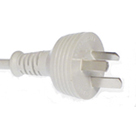
Fully exposed pins
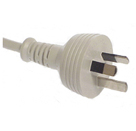
Insulated pins
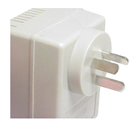
Exposed pins
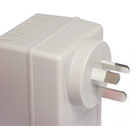
Insulated pins
How to Identify Compliant vs Non-Compliant Plugs
Identifying whether a plug has insulated pins takes a few seconds.
On a compliant plug, the Active and Neutral pins have a visible colour change partway along their length. The lower half of the pin (the section closest to the plug body) will be white, grey, or another non-metallic colour. The tip of the pin remains bare metal for electrical contact.
On a non-compliant plug, the entire length of all pins is bare metal with no insulation sleeve visible.
The Earth pin on both compliant and non-compliant plugs is fully bare metal throughout its length. This is correct and expected. The Earth pin carries no voltage under normal conditions and does not require insulation.
If you have equipment with non-compliant plugs, its approval certificate was cancelled on 3 April 2005. It should not be sold or supplied in Australia. For test and tag purposes, non-compliant plug pins are a fail condition under AS/NZS 3760.
Why the Requirement Was Introduced
The insulated pin requirement was introduced in direct response to a series of incidents in Australia and New Zealand, several of which were fatal. The scenario in each case was consistent: a plug was partially withdrawn from a socket, leaving the Active and Neutral pins partially exposed outside the socket face. A conductive object, typically a metal knife blade, a metal blind slat, or a sheet of metal, made contact with the exposed live pins and caused an electric shock.
Because a standard 10A socket carries 230V at the pin contact point, any conductive bridge between an exposed Active pin and earth or neutral creates an immediate fault current. The insulating sleeve eliminates this risk by covering the exposed section of the pin during withdrawal, so the live metal is never accessible even when the plug is only partially inserted or partially removed.
Each Australian state and territory, and New Zealand, required all electrical equipment to be supplied with insulated pin plugs at all points of sale by 3 April 2005. Approval certificates for equipment with non-insulated pins were cancelled on that date.
Compliance Timeline
| Date | Event |
|---|---|
| 2000 | AS/NZS 3112:2000 published, introducing the insulated pin requirement for the first time. |
| 2004 | AS/NZS 3112:2004 published, adding more stringent pin bending and tip radius tests. |
| 3 April 2005 | Insulated pins became mandatory for all plugs and appliances with integral pins sold in Australia and New Zealand. All approval certificates for non-insulated pin equipment cancelled. |
| 2017 | AS/NZS 3112:2017 published. Current version of the standard. |
Frequently Asked Questions
What are the insulated pins on a plug?
The insulated pins are the Active and Neutral pins on a modern Australian mains plug, which have a non-conductive sleeve covering the lower half of each pin. The sleeve prevents contact with the live section of the pin if the plug is partially withdrawn from the socket. The Earth pin is not insulated because it carries no voltage.
Why is part of my plug pin a different colour?
The colour change partway along the Active and Neutral pins is the insulating sleeve. The non-metallic section (usually white or grey) is the insulation. The bare metal tip at the end is the contact point for the socket. This is correct and means your plug is compliant with AS/NZS 3112.
Is it illegal to sell a plug without insulated pins in Australia?
Yes. Since 3 April 2005, all plugs and appliances with integral pins sold in Australia must have insulated Active and Neutral pins. Approval certificates for non-compliant equipment were cancelled on that date. Supplying non-compliant electrical equipment is an offence under Australian electrical safety legislation in each state and territory.
Do all three pins need to be insulated?
No. Only the Active and Neutral pins require insulation. The Earth pin is fully bare metal and this is correct. The Earth pin carries no voltage under normal operating conditions, so contact with it does not create a shock risk in the same way.
I have old equipment with fully metal pins. Is it still safe to use?
Old equipment with fully exposed pins is non-compliant with the current standard and carries a higher shock risk if the plug is partially withdrawn. While using legacy equipment is not always explicitly prohibited, it should not be resold or supplied to others, and it will fail a test and tag inspection under AS/NZS 3760. Replacing the plug top with a compliant one is straightforward and inexpensive.
Does the Earth pin need to be insulated?
No. The Earth pin is fully bare metal on all compliant plugs and this is intentional. The Earth pin carries no live voltage under normal conditions, so there is no shock risk from contact with it. The insulation requirement applies only to the Active and Neutral pins.
Do plug packs and wall adaptors also need insulated pins?
Yes. The insulated pin requirement applies to all plugs and appliances with integral pins sold in Australia, including plug packs, wall-mount power supplies, and any other device with pins moulded directly into the body. If a plug pack or adaptor has fully exposed metal pins on both Active and Neutral, it is non-compliant and its approval certificate has been cancelled.
Your Project, Perfected. That's The Access Advantage.
- Expert Local Support, Since 1973: Don't waste time with guesswork. Our experts have seen it all and are ready to provide the right solution, right now. Your success is our business.
- Your Specs, Your Brand, Our Build: Off-the-shelf not cutting it? We specialise in building custom cables and assemblies to your exact specifications, branded for your business. Let's create it together.
- Guaranteed for Life: Buy it once. Trust it forever. Our products are backed by a limited lifetime warranty, so you can invest in quality with zero risk. *Warranty excludes third-party brands such as HALO and UPS.
Let's get your project started.
Talk to an expert today for a custom quote or browse the solutions most relevant to your search.