
A guide to Australian telephone wiring
Quick answer
- Tip is the positive side of a telephone line, ring is the negative side, terminology that still applies across every plug and socket type.
- Mode 3 wiring is the standard for connecting monitored alarm panels, letting the panel seize the line to make an outgoing call.
- Access Communications stocks RJ11, RJ12, and 605/610 adaptors for joining, extending, or converting telephone lines.
Connecting telephones, alarm panels, fax machines or NBN equipment in an Australian home or business means understanding a few foundational concepts: the names of the two telephone wires (tip and ring), the wiring modes used to share a line between devices, and the pinouts of the common Australian plugs and sockets. This guide covers all of them in one place.
For background on the colour code system used in multi-pair telephone cabling, see our 25 pair colour code guide. For deeper context on the history of Australian telephone plugs and the adaptors that bridge old and modern equipment, see our Australian telephone plugs and sockets guide.
Tip and ring: the foundation of telephone wiring
The two wires of a telephone line are traditionally called "tip" and "ring". The names date back to the original 1/4 inch telephone plug (similar in appearance to a standard 6.5mm phono plug), where one electrical contact was at the very tip of the plug and the other was a ring around the body just behind it.
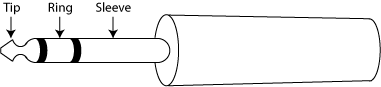
The tip is the positive (+) side of the line, the ring is the negative (-) side. This terminology is still the standard way to identify the polarity of any phone pair, whether the connection is on a 605 plug, a 610 socket, an RJ11 modular jack or a 25-pair distribution frame.
Conventional nomenclature
| Term | Also known as | Polarity | Legacy colour |
|---|---|---|---|
| TIP | A-wire | Line (+) positive | Red |
| RING | B-wire | Line (-) negative | Black |
Wiring modes for auxiliary devices
Wiring modes refer to the configurations used to connect auxiliary equipment like alarm panels, fax machines, or modems to a telephone service. Mode 3 is by far the most common configuration, particularly for monitored security alarms that need to seize the line to make an outgoing call.
Mode 3 wiring
Mode 3 allows an alarm panel to seize the phone line and override any other device on the line when an alarm condition triggers an outgoing call. It is the standard method for connecting monitored security systems in Australia.
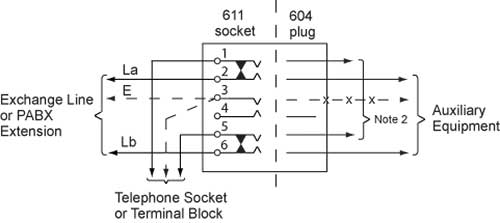
Notes on Mode 3 wiring:
- If an earth is required for recall functions, it should be connected to the telephone. If the auxiliary equipment requires an earth, it is connected separately.
- Connection to the switching terminals is only required where the auxiliary equipment incorporates facilities for switching the line to the telephone.
- Where the telephone is connected to a 4-wire extension from a PABX, the fourth wire is terminated on terminal 4 of the 611 socket.
RJ12 6P6C plug and socket pinout (USOC)
USOC stands for Universal Service Order Code, a pinout standard developed by the Bell System for telephone services. RJ12 is a six-position, six-contact (6P6C) modular plug, used for up to three-line telephone connections. The USOC wiring scheme is symmetrical: pair 1 is on the centre two pins, pair 2 on the pair outside that, and pair 3 on the outer pins. RJ11 (6P2C, single line) and RJ14 (6P4C, two line) follow the same pin numbering, simply using fewer contacts.
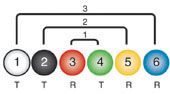
| Pair | Tip (+) colour | Pin # | Ring (-) colour | Pin # |
|---|---|---|---|---|
| Pair 1 | Green | 4 | Red | 3 |
| Pair 2 | Black | 2 | Yellow | 5 |
| Pair 3 | White | 1 | Blue | 6 |
Access stocks a full range of RJ11 and RJ12 adaptors, couplers and sockets for joining, extending or converting telephone lines.
Australian 605 plug pinout
The 605 plug is the traditional Australian telephone plug, introduced by Telecom Australia (now Telstra) in the 1960s as part of the "colorfone" range. It has either 4 or 6 conductors and mates with 610, 611 or 612 sockets. The 605 plug remains in use in millions of Australian homes and is still required for connecting older telephone equipment to modern wall outlets via an adaptor.
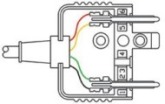
| Pair | Tip (+) colour | Pin # | Ring (-) colour | Pin # |
|---|---|---|---|---|
| Pair 1 | Green | 2 | Red | 6 |
| Pair 2 | Black | 1 | Yellow | 5 |
Access stocks a range of 605 and 610 adaptors for converting between old Australian sockets and modern RJ11, RJ12 or RJ45 connections.
Australian 610 socket pinout
The 610 socket is the traditional Australian telephone wall socket, designed to accept the 603, 605 or 606 plugs. The 610 socket has 6 connectors with screw terminals used to terminate premises cable, and is still found in most Australian homes built before the early 2000s. To connect modern phones, faxes or modems to an existing 610 socket, an Access 610 to RJ11 or RJ12 adaptor is the simplest solution.
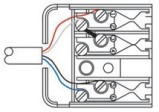
| Pair | Tip (+) colour | Pin # | Ring (-) colour | Pin # |
|---|---|---|---|---|
| Pair 1 | White | 2 | Blue | 6 |
| Pair 2 | Red | 1 | Black | 5 |
Frequently asked questions
What is tip and ring in telephone wiring?
Tip and ring are the two conductors that make up a single telephone line. The tip is the positive (+) side of the line, the ring is the negative (-) side. The names come from the original telephone switchboard plugs, where one connection was made at the tip of the plug and the other at a ring around the plug body.
What is Mode 3 wiring?
Mode 3 is an Australian telephone wiring configuration that allows an alarm panel (or similar auxiliary device) to seize the phone line and override any other device when making an outgoing call. It is the standard method for connecting monitored security alarms to a telephone service.
What is USOC?
USOC stands for Universal Service Order Code. It is a North American telephone wiring scheme developed by the Bell System, used for analogue telephone services on RJ11, RJ14 and RJ12 modular connectors. USOC arranges pairs symmetrically from the centre of the connector outwards, allowing 1, 2 or 3 pair phone systems to share the same socket layout.
What is the difference between RJ11, RJ12 and RJ14?
All three are modular telephone connectors in the same 6-position housing, distinguished by the number of contacts used. RJ11 (6P2C) uses two contacts for a single phone line. RJ14 (6P4C) uses four contacts for two phone lines. RJ12 (6P6C) uses all six contacts for up to three lines. All three follow the same USOC pin numbering.
Does the 605 plug still work in modern Australian homes?
Yes. The 605 plug is still widely supported. Most modern Australian wall outlets either include an old-style 610 socket alongside a modern RJ12 socket, or accept an adaptor that converts between the two. Adaptors and double-adaptors that combine 605, 610 and RJ12 are readily available.
What is the difference between a 605 plug and a 610 socket?
The 605 plug is the cable-end connector traditionally used on Australian telephones. The 610 socket is the wall-mounted receptacle that accepts the 605 plug. They are designed to mate with each other. Both date from the Telecom Australia era of the 1960s onwards.
Your Project, Perfected. That's The Access Advantage.
- Expert Local Support, Since 1973: Don't waste time with guesswork. Our experts have seen it all and are ready to provide the right solution, right now. Your success is our business.
- Your Specs, Your Brand, Our Build: Off-the-shelf not cutting it? We specialise in building custom cables and assemblies to your exact specifications, branded for your business. Let's create it together.
- Guaranteed for Life: Buy it once. Trust it forever. Our products are backed by a limited lifetime warranty, so you can invest in quality with zero risk. *Warranty excludes third-party brands such as HALO and UPS.
Let's get your project started.
Talk to an expert today for a custom quote or browse the solutions most relevant to your search.