
RJ45 wiring diagrams: T568A and T568B
Quick answer
- For new Australian commercial installations, use T568B, the default for most patch panels, keystones, and patch leads sold locally.
- Both ends of any single cable run must use the same standard, never mix T568A and T568B unless deliberately making a crossover cable.
T568A and T568B are the two standard wiring patterns for terminating an eight-position, eight-contact (8P8C) RJ45 plug or jack to a twisted-pair data cable. Both standards use the same eight wires arranged in four pairs, but the orange and green pairs are swapped between them. T568A and T568B are functionally identical for Ethernet performance, however it is essential that both ends of any single cable use the same standard.
This guide covers the pinout for both standards plus a practical comparison for Australian installers. For background on the underlying 25-pair colour code, see our 25 pair colour code guide. For telephone wiring (USOC, RJ12, Australian 605 plug and 610 socket), see our Australian telephone wiring guide.
T568A configuration (RJ45 8P8C)
T568A is the older of the two TIA-568 wiring patterns and offers backward compatibility with both one-pair and two-pair USOC telephone wiring. It is the standard often specified for US federal government contracts and some Australian government and defence work that follows US specifications.
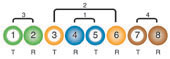
| Pair | Tip (+) colour | Pin # | Ring (-) colour | Pin # |
|---|---|---|---|---|
| Pair 3 (Green) | Green/White | 1 | Green | 2 |
| Pair 2 (Orange) | Orange/White | 3 | Orange | 6 |
| Pair 1 (Blue) | Blue/White | 5 | Blue | 4 |
| Pair 4 (Brown) | Brown/White | 7 | Brown | 8 |
T568B configuration (RJ45 8P8C)
T568B is the most widely used wiring pattern for RJ45 terminations in Australian commercial installations. The vast majority of patch panels, keystones, jacks and factory-terminated patch leads sold through Australian trade channels are wired T568B by default. The only practical difference between T568A and T568B is that the orange and green pairs are swapped.
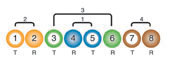
| Pair | Tip (+) colour | Pin # | Ring (-) colour | Pin # |
|---|---|---|---|---|
| Pair 2 (Orange) | Orange/White | 1 | Orange | 2 |
| Pair 3 (Green) | Green/White | 3 | Green | 6 |
| Pair 1 (Blue) | Blue/White | 5 | Blue | 4 |
| Pair 4 (Brown) | Brown/White | 7 | Brown | 8 |
T568A vs T568B: which to use in Australia
The question of which standard to use comes up on almost every job. Here is the practical answer for Australian installers.
| Aspect | T568A | T568B |
|---|---|---|
| Pin 1 and 2 | Green pair | Orange pair |
| Pin 3 and 6 | Orange pair | Green pair |
| Pin 4, 5, 7, 8 | Blue and Brown pairs (same) | Blue and Brown pairs (same) |
| Common in | Residential, US government, older systems | Commercial, most AU trade |
| USOC backward compatibility | Yes (1 and 2 pair) | Yes (1 pair only) |
| Ethernet performance | Identical | Identical |
Practical recommendation: For new Australian commercial installations, use T568B. Most patch panels, keystones, jacks and patch leads sold in Australia are wired T568B by default. If a product specification does not state otherwise, assume T568B. The critical rule is consistency: both ends of any single cable run must use the same standard. Never mix T568A on one end and T568B on the other unless you are deliberately making a crossover cable, which is rarely needed on modern Ethernet equipment because most ports now auto-detect.
Frequently asked questions
Should I use T568A or T568B in Australia?
For new commercial installations in Australia, use T568B. Most patch panels, keystones, jacks and patch leads sold through Australian trade channels are wired T568B by default. T568A is generally only required where existing wiring uses it, or where US federal contracts specify it. Both standards perform identically for Ethernet, so the most important rule is consistency: both ends of any single cable must use the same standard.
What is the difference between T568A and T568B?
The only difference is that the orange and green pairs are swapped. In T568A, the green pair is on pins 1 and 2 and the orange pair is on pins 3 and 6. In T568B, the orange pair is on pins 1 and 2 and the green pair is on pins 3 and 6. The blue and brown pairs are in the same positions in both standards.
What is the difference between RJ45 and 8P8C?
RJ45 and 8P8C describe the same physical connector. 8P8C (eight-position, eight-contact) is the technical name for the modular plug and jack with eight pins. RJ45 is the older registered jack designation that has become the common name in the data networking industry. The terms are used interchangeably.
Can I make a crossover cable by using T568A at one end and T568B at the other?
Yes. A crossover cable is one with T568A on one end and T568B on the other. However, crossover cables are rarely needed today because most modern Ethernet equipment supports Auto-MDIX, which automatically detects and corrects the wiring polarity. For all standard Ethernet connections, use the same standard at both ends.
Why are some pairs not next to each other on the connector?
The pin layout for T568A and T568B is the result of preserving compatibility with older telephone wiring while supporting Ethernet. Pair 1 (blue) is on pins 4 and 5 in the centre of the connector, where it would have carried a single phone line on USOC wiring. The Ethernet pairs (2 and 3) are split across non-adjacent pins to maintain this compatibility while still meeting twisted-pair signalling requirements.
Your Project, Perfected. That's The Access Advantage.
- Expert Local Support, Since 1973: Don't waste time with guesswork. Our experts have seen it all and are ready to provide the right solution, right now. Your success is our business.
- Your Specs, Your Brand, Our Build: Off-the-shelf not cutting it? We specialise in building custom cables and assemblies to your exact specifications, branded for your business. Let's create it together.
- Guaranteed for Life: Buy it once. Trust it forever. Our products are backed by a limited lifetime warranty, so you can invest in quality with zero risk. *Warranty excludes third-party brands such as HALO and UPS.
Let's get your project started.
Talk to an expert today for a custom quote or browse the solutions most relevant to your search.