
An in-depth guide to coaxial cable
Quick answer
- RG6 Quad-shield is the standard for digital TV, satellite, and MATV. RG59 suits short analogue CCTV runs. RG11 suits long backbone runs over 60m.
- Quad-shield is the minimum requirement under current Australian Standards for digital TV antenna cabling.
Coaxial cable, or "coax", is the standard for transmitting video and high-frequency signals over a single conductor. It carries everything from your free-to-air TV antenna feed to high-definition CCTV, satellite, and MATV distribution across Australian homes and commercial buildings. The name "coaxial" refers to the common axis shared by its two conductors.
This guide covers how coax is built, the differences between RG6, RG59 and RG11, which cable suits which job, and the connectors used to terminate them. If you need help selecting connectors and tools for a specific cable, our Coaxial Connector and Tool Guide has a full reference table.
How a coaxial cable is constructed
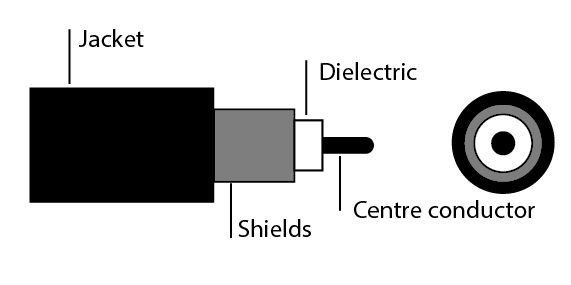
Every coaxial cable shares the same four-layer construction:
- Centre conductor: solid copper or copper-clad steel (CCS). Carries the signal.
- Dielectric insulator: usually foamed polyethylene. Separates the conductor from the shield.
- Shielding: one or more layers of aluminium foil and/or braided wire. Blocks electromagnetic interference (EMI) and radio frequency interference (RFI).
- Outer jacket: PVC or low-smoke jacket for protection.
Most coax used for video has a nominal impedance of 75 ohms. Cables built for RF, two-way radio and some test equipment use 50 ohms. The two are not interchangeable.
What the "RG" designation means
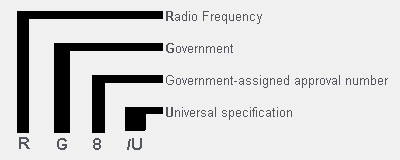
"RG" stands for Radio Guide, a US military classification dating back to the 1930s. The number that follows identifies the cable type, and a letter (A, B, or C) before the slash indicates a specification revision. For example, RG-8A/U supersedes RG-8/U.
The RG numbers themselves are not sequential or logical. RG6 is not "better" than RG59 simply because the number is smaller. Each cable was designed for a specific application.
Common coaxial cable types in Australia
For Australian video, antenna, satellite and CCTV applications, three cable types dominate: RG59, RG6 and RG11.
| Specification | RG59/U | RG6/U Quad-shield | RG11/U Quad-shield |
|---|---|---|---|
| Outer diameter | ~6.1mm | ~7.5mm | ~10.3mm |
| Centre conductor | 20-22 AWG copper or CCS | 18 AWG CCS | 14 AWG CCS |
| Impedance | 75 ohm | 75 ohm | 75 ohm |
| Shielding | Single or dual | Quad (2x foil, 2x braid) | Quad (2x foil, 2x braid) |
| Signal loss (longer = worse) | Highest | Moderate | Lowest |
| Typical run length | Short runs (under 30m) | Standard runs (up to 60m) | Long backbone runs (60m+) |
| Primary use | Analogue CCTV, basic antenna | Digital TV, MATV, SATV, CATV | Backbone, long distribution |
Quad-shield versus dual-shield
"Dual-shield" cable has one layer of foil and one layer of braid. "Quad-shield" has two layers of each. Quad-shield offers significantly better protection against interference and is the minimum requirement under current Australian Standards for digital TV antenna cabling and MATV systems. For any new install, quad-shield is the safe choice.
Which coaxial cable for which job
| Application | Recommended cable |
|---|---|
| Digital TV antenna (free-to-air) | RG6/U Quad-shield |
| MATV (master antenna for multi-dwelling buildings) | RG6/U Quad-shield (backbone in RG11/U) |
| SATV (satellite TV including Foxtel) | RG6/U Quad-shield |
| CATV (cable TV distribution) | RG6/U Quad-shield |
| Analogue CCTV, short runs | RG59/U |
| HD CCTV over coax (HD-TVI, HD-CVI, AHD) | RG59/U (short runs) or RG6/U (longer runs) |
| Long backbone runs (over 60m) | RG11/U Quad-shield |
HD CCTV over coaxial cable
One of the most significant developments in CCTV over the last decade has been the shift from analogue PAL/NTSC video to high-definition formats that run over the same coaxial infrastructure. This means an existing analogue CCTV install can often be upgraded to 1080p, 4MP or even 8MP without pulling new cable.
The four HD-over-coax standards installers will encounter are:
- HD-TVI (High Definition Transport Video Interface), associated with Hikvision.
- HD-CVI (High Definition Composite Video Interface), associated with Dahua.
- AHD (Analog High Definition), an open standard used by multiple manufacturers.
- CVBS (Composite Video Baseband Signal), the legacy analogue format.
All four use 75 ohm BNC connectors on RG59 or RG6 cable. The cable and connectors are the same, only the cameras and recorder change. For installers, this makes BNC the workhorse coaxial connector for the security trade.
Common coaxial connectors
Three connector families dominate Australian coaxial work: BNC, F-Type and PAL. Each has its own application, and each requires a matching crimp or compression tool. For the full connector-to-tool reference, see our Coaxial Connector and Tool Guide.
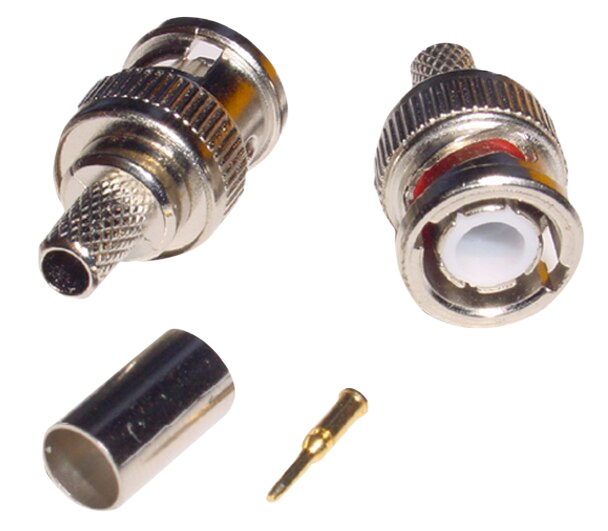
BNC connectors use a quarter-turn bayonet locking mechanism and are the standard for CCTV, including HD-over-coax systems. They are the most common termination for RG59, and are also used on RG6 in HD-TVI, HD-CVI and AHD installs. Access stocks BNC crimp connectors for both RG59 and RG6, plus BNC-to-BNC couplers and BNC-to-RCA adaptors.
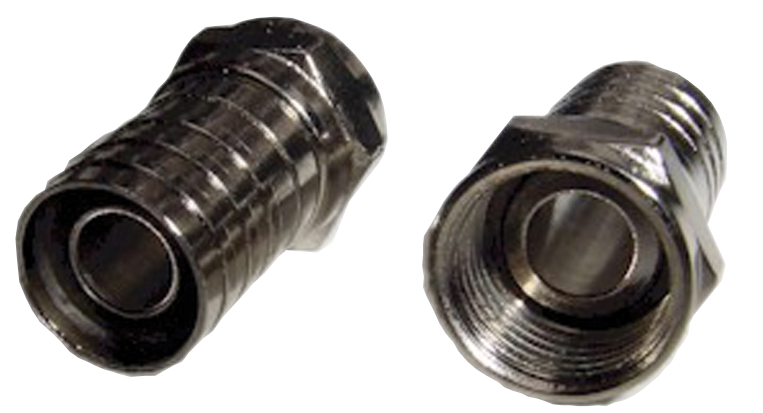
F-Type connectors are screw-on connectors used for digital TV, MATV, SATV, CATV and Foxtel work. They are typically paired with RG6 Quad-shield or RG11. The cable's centre conductor forms the inner pin of the connector, so no separate pin is required. F-Type connectors are available in crimp and compression styles, with compression generally preferred for outdoor and weatherproof installs.
F-Type connector naming
| Connector name | Application |
|---|---|
| F-59, F-6, F-11 | Male connector for terminating onto RG59, RG6, or RG11 cable. |
| F-61 | Panel-mount female F-connector. |
| F-71 | Male-to-male F-connector adaptor. |
| F-81 | Female-to-female F-connector used as a joiner or in wall plates. |
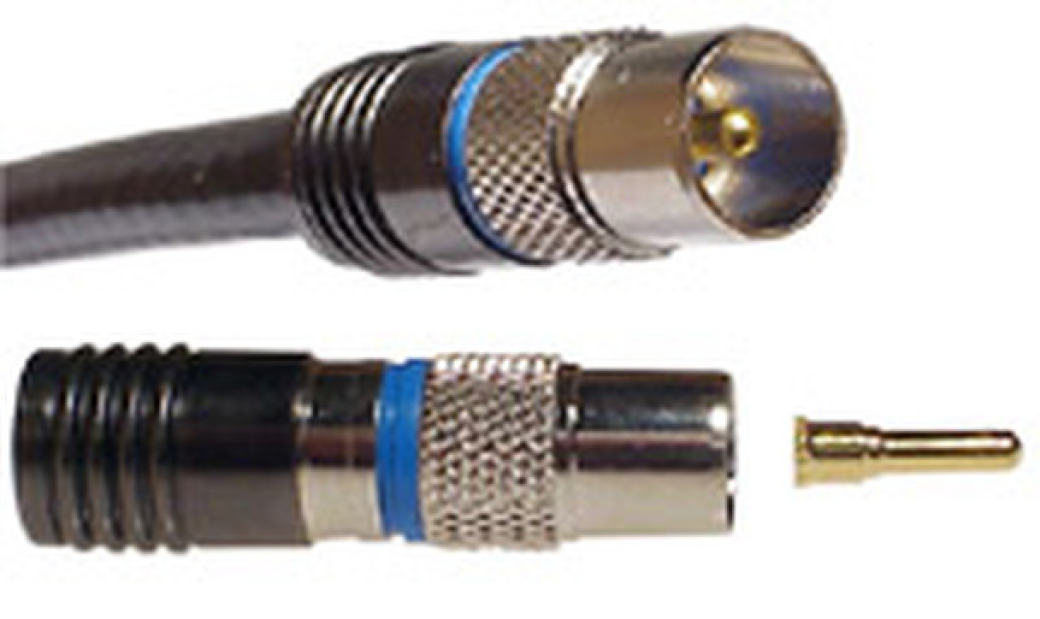
PAL (Belling-Lee) connectors are a push-on connector that has traditionally been used for TV antenna wall plates and older television equipment in Australia. PAL is being progressively replaced by F-Type for digital and satellite applications, but it remains in use in millions of existing Australian installations.
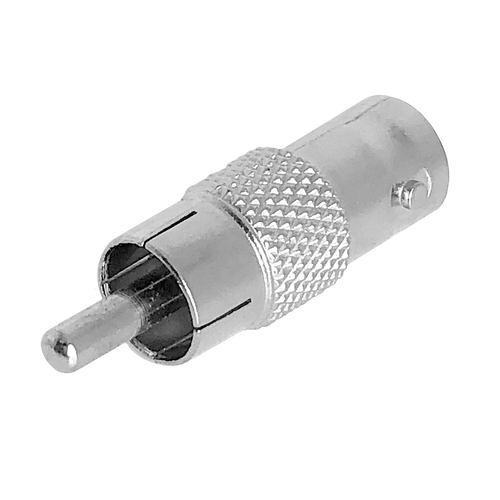
Adaptors bridge between connector types. Where a BNC connection is required onto RG6 cable, the recommended method is to terminate the cable with an F-Type connector and use an F-Type to BNC adaptor. Access stocks a range of coaxial adaptors including BNC to RCA, BNC couplers, and F-Type to BNC.
Need cable, connectors or tools?
Access Communications supplies the full range of coaxial connectors, crimp tools, and termination accessories for trade installers across Australia. For coaxial cable on the reel (RG59, RG6 Quad-shield or RG11) we can order to your specifications. Contact our team for a quote.
Frequently asked questions
What is a coaxial cable used for?
Coaxial cable transmits high-frequency video and RF signals between equipment. The most common uses are TV antenna, satellite TV, cable TV distribution, MATV systems in multi-dwelling buildings, and CCTV (both analogue and HD-over-coax).
What is the difference between RG6 and RG59?
RG6 has a thicker centre conductor and lower signal loss, making it the standard for digital TV, satellite and longer cable runs. RG59 is thinner with higher signal loss and is best suited to analogue CCTV and short cable runs. They are not interchangeable.
What is the difference between RG6 and RG11?
RG11 is significantly thicker than RG6 (around 10.3mm vs 7.5mm outer diameter) and has lower signal loss, making it suitable for backbone cabling and long distribution runs over 60 metres. RG6 is more flexible and easier to install for standard runs.
What is quad-shield coaxial cable?
Quad-shield cable has four layers of shielding (two layers of foil and two layers of braid) instead of the two layers in dual-shield. It offers superior protection against electromagnetic and radio frequency interference and is the minimum requirement under current Australian Standards for digital TV antenna cabling.
Can I use the same coaxial cable for CCTV and TV?
Both use 75 ohm coaxial cable, but the typical choice differs. CCTV traditionally uses RG59 for short runs and RG6 for longer runs with HD-over-coax cameras. TV antenna and satellite installs use RG6 Quad-shield. The connectors are also different: BNC for CCTV, F-Type for TV.
Can I run HD CCTV over old analogue coaxial cable?
Yes. HD-TVI, HD-CVI and AHD all transmit high-definition video over the same RG59 or RG6 coaxial cable used for analogue CCTV. Upgrading an analogue site to HD requires new cameras and a new DVR but does not require new cable, provided the existing coax and BNC connectors are in good condition.
Your Project, Perfected. That's The Access Advantage.
- Expert Local Support, Since 1973: Don't waste time with guesswork. Our experts have seen it all and are ready to provide the right solution, right now. Your success is our business.
- Your Specs, Your Brand, Our Build: Off-the-shelf not cutting it? We specialise in building custom cables and assemblies to your exact specifications, branded for your business. Let's create it together.
- Guaranteed for Life: Buy it once. Trust it forever. Our products are backed by a limited lifetime warranty, so you can invest in quality with zero risk. *Warranty excludes third-party brands such as HALO and UPS.
Let's get your project started.
Talk to an expert today for a custom quote or browse the solutions most relevant to your search.