
Reading the Rating Plate on Any Power Supply
The rating plate on a low-voltage power supply carries a set of standardised symbols and abbreviations that tell you everything critical about that supply: its voltage, current, polarity, waveform type, equipment class, and safety certifications. Reading these correctly prevents equipment damage, ensures safe installation, and confirms compliance. This guide covers every symbol and abbreviation you will encounter.
Guide Index
- DC Output Polarity Symbols
- AC and DC Waveform Symbols
- Common Abbreviations
- Equipment Class Symbols
- Safety and Construction Symbols
- How to Read a Power Supply Label
- Frequently Asked Questions
DC Output Polarity Symbols
The polarity symbol is the most important marking on a DC power supply label. It shows whether the centre pin (tip) of the output barrel connector is positive or negative. Using a supply with the wrong polarity will damage or destroy the connected device instantly in most cases, and is not covered by warranty.
Centre Positive (Most Common)
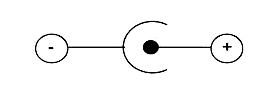
The centre pin (tip) of the output plug is Positive (+) and the outer barrel is Negative (-). This is the standard polarity for the vast majority of consumer and commercial electronics: routers, access points, CCTV cameras, LED drivers, and most networking and IT equipment.
Centre Negative (Less Common)
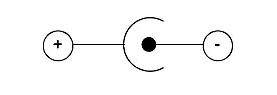
The centre pin (tip) of the output plug is Negative (-) and the outer barrel is Positive (+). Less common in modern equipment but found on some older audio gear, guitar effects pedals, and certain specialist devices. Always check before connecting a replacement supply.
How to read the polarity symbol: The symbol shows a circle with a dot in the centre (representing the barrel tip) and a larger arc (representing the outer sleeve). The + and - signs indicate which is which. If the + is next to the dot, the supply is centre positive. If the - is next to the dot, it is centre negative.
If the label is missing or unreadable: Use a multimeter set to DC voltage. Place the red probe inside the barrel tip and the black probe against the outer sleeve. A positive reading confirms centre positive. A negative reading confirms centre negative.
AC and DC Waveform Symbols
These symbols appear on the rating plate to indicate the type of electrical current the supply uses for its input and output.
| Symbol | Meaning | Where You See It |
|---|---|---|
 |
Direct Current (DC). A solid line over a dashed line. Indicates steady unidirectional current flow. All low-voltage power supply outputs are DC. | Output section of power supply label, next to the output voltage (e.g. 12V ⎓) |
| ~ (tilde / wavy line) | Alternating Current (AC). A wavy line or tilde symbol. Indicates the oscillating current from the mains supply. All Australian mains outlets supply AC at 230V, 50Hz. | Input section of power supply label, next to the input voltage (e.g. 100-240V~) |
A label showing INPUT: 100-240V~ 50/60Hz and OUTPUT: 12V ⎓ 2A means: the supply accepts global mains voltage (compatible with both Australian 230V and international 110-120V), and delivers 12 volts DC at up to 2 amps. This is the most common label format on modern switch-mode power supplies.
Common Abbreviations
| Abbreviation | Meaning | Abbreviation | Meaning |
|---|---|---|---|
| V | Volts | Hz | Hertz (cycles per second) |
| A | Amperes (amps) | PRI | Primary (mains input side) |
| mA | Milliamperes (1/1000 of an amp) | SEC | Secondary (DC output side) |
| VAC | Volts AC | AC | Alternating Current |
| VDC | Volts DC | DC | Direct Current |
| W | Watts (V × A = W) | VA | Volt-Amperes (apparent power) |
| ELVPSU | Extra Low Voltage Power Supply Unit | SMPS | Switch-Mode Power Supply |
| SELV | Safety Extra Low Voltage (below 50V AC or 120V DC) | LPS | Limited Power Source |
Equipment Class Symbols
Equipment class symbols define how a power supply is protected against electric shock. This determines whether the supply requires an earth connection and what type of cord it uses.
| Class | Symbol | What It Means | Cord Required | Common Examples |
|---|---|---|---|---|
| Class I |  |
Protection relies on basic insulation plus a protective earth connection. If insulation fails, fault current flows to earth and trips the circuit breaker rather than through the user. | 3-conductor cord with earth (standard Australian 3-pin plug) | Desktop computers, most commercial power supplies, AV equipment with metal chassis |
| Class II |  |
Double insulated. Two independent layers of insulation between the user and live parts. No earth connection required because the double insulation provides equivalent protection. | 2-conductor cord (no earth). Often uses a Figure-8 C7 or 2-pin plug. | Laptop adapters, phone chargers, most plug-pack power supplies, small consumer electronics |
| Class III | III (Roman numerals in a diamond) | Operates from Safety Extra Low Voltage (SELV): below 50V AC or 120V DC. At these voltages, dangerous electric shock is not possible under normal conditions. | Powered from SELV source only. Must not connect directly to 230V mains. | 12V LED strip drivers, 24V door bell transformers, low-voltage landscape lighting |
Important: Never replace a Class I 3-conductor power supply with a Class II 2-conductor supply unless the equipment nameplate explicitly states Class II. Removing the earth connection from Class I equipment eliminates its primary shock protection.
Safety and Construction Symbols
| Symbol | Name | What It Means |
|---|---|---|
|
Direct Current | Solid line over dashed line. The output is DC. Appears next to the output voltage on the label. |
|
Protective Earth | Three horizontal lines forming a downward triangle. The equipment chassis is connected to protective earth. A 3-conductor earthed cord must be used. Never bypass the earth connection. |
|
Class II / Double Insulation | Square within a square. The supply is double insulated and does not require an earth connection. A 2-conductor cord is acceptable. |
 |
Safety Isolating Transformer | The supply uses a safety isolating transformer that provides galvanic isolation between the mains input and the DC output. The output circuit is electrically isolated from the mains supply, significantly reducing shock risk. |
 |
Fuse Link | The supply contains an internal fuse. If a fault causes excessive current draw, the fuse interrupts the circuit before damage occurs. Never replace an internal fuse with a higher-rated one. |
 |
Short-Circuit Proof Transformer | The transformer is designed to withstand a continuous short circuit on its output without catching fire or causing a hazard. Common on plug-pack supplies used for doorbells, security systems, and similar low-voltage applications. |
How to Read a Power Supply Label
A typical switch-mode plug-pack label contains all of the following information. Here is how to read it systematically before connecting any replacement supply.
| Label Section | Example | What to Check |
|---|---|---|
| Input voltage | INPUT: 100-240V~ 50/60Hz | Must include 230V or show a range that covers 230V for Australian use. The ~ confirms AC input. |
| Output voltage | OUTPUT: 12V ⎓ | Must exactly match the voltage required by the device. The ⎓ confirms DC output. |
| Output current | 2.0A | Must equal or exceed the current required by the device. A higher-rated replacement supply is safe. A lower-rated one will overheat and fail. |
| Polarity | Polarity symbol | Must match the polarity required by the device. Verify centre positive or centre negative. This is the most critical check. |
| Equipment class | Double square (Class II) | Confirms whether the supply requires earth connection. Most plug-packs are Class II. |
| Compliance mark | RCM mark | Confirms the supply is legally approved for sale in Australia. Any replacement supply must carry RCM certification. |
Frequently Asked Questions
What does the polarity symbol on a power supply mean?
The polarity symbol shows whether the centre pin (tip) of the DC output barrel connector is positive or negative. A circle with a dot in the centre represents the barrel tip, and a larger arc represents the outer sleeve. The + and - signs show which is which. Centre positive (+ next to the dot) is the most common configuration for consumer and commercial electronics. Always match the polarity of a replacement supply to the polarity of the original.
What does the DC symbol look like on a power supply?
The DC (Direct Current) symbol is a solid horizontal line with a dashed line below it. It appears next to the output voltage on the power supply label, confirming the output is DC. The mains input uses a wavy line or tilde (~) to indicate AC. A label showing INPUT: 230V~ and OUTPUT: 12V ⎓ means the supply takes 230V AC from the wall and delivers 12V DC.
What is the double square symbol on a power supply?
The double square symbol (a small square inside a larger square) indicates Class II construction, meaning the supply is double insulated. Class II supplies have two independent layers of insulation between the user and live parts and do not require a protective earth connection. This is why most plug-pack power supplies use a 2-pin plug rather than a 3-pin earthed plug.
What does centre negative mean on a power supply?
Centre negative means the centre pin (tip) of the DC barrel output is the negative (-) conductor and the outer sleeve is positive (+). This is the opposite of the more common centre positive configuration. Guitar effects pedals and some older audio equipment commonly use centre negative supplies. Using a centre positive supply on centre negative equipment, or vice versa, will damage the device.
Can I use a higher amperage power supply as a replacement?
Yes, as long as the voltage and polarity match exactly. A power supply only delivers the current the device draws. If your device draws 1A and you use a 2A-rated supply, the supply will simply deliver 1A and the rest of its capacity goes unused. A lower-rated replacement is not safe: a supply rated below the device's actual current draw will overheat, fail prematurely, or cause damage to the device.
What is the protective earth symbol on a power supply?
The protective earth symbol is three horizontal lines forming a downward-pointing triangle. It indicates the equipment chassis is connected to protective earth through the power cord. Equipment with this symbol must be used with a 3-conductor earthed cord and a properly earthed outlet. Never use an adaptor that bypasses the earth pin on a supply marked with the protective earth symbol.
What does RCM mean on a power supply?
RCM stands for Regulatory Compliance Mark. It is the mandatory compliance mark for electrical equipment sold in Australia and New Zealand, confirming the product meets Australian electrical safety, electromagnetic compatibility, and telecommunications standards. Any power supply sold legally in Australia must carry the RCM mark. See our Product Compliance guide for full details.
Your Project, Perfected. That's The Access Advantage.
- Expert Local Support, Since 1973: Don't waste time with guesswork. Our experts have seen it all and are ready to provide the right solution, right now. Your success is our business.
- Uncompromising Aussie Quality: We live and breathe quality. From rigorous testing to official Australian certification, we guarantee every product we sell is built to perform and built to last.
- Your Specs, Your Brand, Our Build: Off-the-shelf not cutting it? We specialise in building custom cables and assemblies to your exact specifications, branded for your business. Let's create it together.
- Guaranteed for Life: Buy it once. Trust it forever. Our products are backed by a limited lifetime warranty, so you can invest in quality with zero risk. *Warranty excludes third-party brands such as HALO and UPS.
- Innovation That Keeps You Ahead: The tech landscape is always changing, and so is our catalogue. We ensure you always have access to the latest, most reliable solutions on the market.
Let's get your project started.
Talk to an expert today for a custom quote or browse the solutions most relevant to your search.